
These rules require no order writing or cards. The only marker required is cotton wool or tissue paper for indicating Pinned and Disrupted status. They are designed for 2mm figures to be played on a two-foot board in an hour or less. The rules are solo-gamer friendly.
These rules differentiate themselves by two core mechanics.
This is the trait of Napoleonic infantry to refuse to budge once it had started firing at an enemy. This made the commitment of units an important decision, as the general was unlikely to regain control over them again for some time.
Napoleonic battles were rarely set-piece battles. Units would arrive in clumps and make their way towards the front, often arriving from the flanks. This gives a very different feel than a battle where the units are all lined up facing each other at the start.
Each unit represents a regiment, or in some cases a brigade. The game can represent either part of a larger battle, or a smaller battle in its entirety. Based on the army lists, the “sides” represent approximately a corps with support. Larger, multi-corps battles should include a corps headquarters and an overall army HQ.
Estimated scale is 1″ = 100 to 200 yards; time scale is estimated at about 30 minutes. Multi-corps battles should have a 2 × 2 ft area for each “corps”. Since regiments and brigades were never of a standard size, there are three options for sizes: Large, Common, and Small. This applies to infantry for firing and melee, and to cavalry for melee only.
Large units are considered to be larger than 2,000 rank and file; Common-sized between 800 and 1,999 rank and file; and Small less than 800 (for historical recreations only).
The rules are designed for 2mm figures to be played on a 2 ft × 2 ft table — hence “2 by 2” — which can be played to completion in an hour or so. There is no ground or time scale beyond it “feeling” right.
All units are based on 1 inch by ½ inch bases. The author doubles up stands on the base to make a more attractive appearance, but single blocks are equally fine. Stand size can vary, so long as all units are similarly based. Some testers have used 40 mm (approx. 1½ inch) base frontage with no adverse effect on gameplay.
A word on unit formations: as you, the player, are playing at a higher command level, the individual unit commanders are presumed to change unit formations at their discretion (for example, an infantry unit preparing to receive a cavalry charge would presume to change to square). Therefore, unit formations are not shown on the table.
The armies of the period were composed of a handful of distinct unit types, each with its own temperament and battlefield rôle. The following are the types you will field in 2 by 2 Napoleonic's.
At the start of the game, players may decide on a “Fast” or “Decisive” game. A Decisive game can last longer but gives a slightly more agreeable result; Fast games are usually over in less than an hour and are very much sudden-death games.
A Fast game is lost by the first player who has 5 units Destroyed.
A Decisive game is lost by the first player to lose 5 units or more and who has lost 2 more units than the opponent.
Draws are possible and common in 2 by 2 Napoleonic's. A player may start to play for a draw only after either side has no reinforcements left (that is, all reinforcements for that player or the opponent are on table). A draw is achieved by exiting all of that player's units off that player's table edge. Note that units forced off the table by routing count as Destroyed and so towards victory — this exiting strategy is difficult to pull off.
If playing for a draw, players are advised to first disengage their infantry from the enemy, then use artillery and cavalry to cover the retreat, with cavalry being the last off the board.
Each player rolls 1D6. If the dice are tied, each player may place an extra 10AP at the start of the game, then re-roll. It is possible in this manner for all the AP to be set up at the start of the battle eventually. The player with the higher score is the attacker, the lower the defender.
The low scorer chooses the terrain from that available (four to six features should be adequate, but feel free to go overboard — this is 2mm after all, pack that board full of terrain, it looks great!). Location may be determined by die roll or by mutual agreement. If rolling, divide the board into six equal terrain sectors: 1, 2, and 3 across the attacker half from left to right; 4, 5, and 6 across the defender half from left to right, as shown in Plate I.
Features should be placed in the following order, placing each within the sector rolled for:
The defender places 10AP of units within 6″ of their base edge, but no closer than 3″ to the side of the board. The attacker places 10AP of units within 6″ of their base edge, but no closer than 3″ to the side of the board.
The defender then picks a reinforcement point anywhere on their defending edge of the board and places the reinforcements they intend to arrive there next to it in order of appearance.
The attacker then picks a reinforcement point anywhere on their edge of the board or anywhere on either flank that is not within 6″ of a defending unit or reinforcement point. They then place the reinforcements they intend to arrive there next to it in order of appearance.
The defender then picks a second reinforcement point anywhere on their defending edge of the board and places the reinforcements they intend to arrive there next to it in order of appearance.
The attacker then picks a second reinforcement point anywhere on their edge of the board or anywhere on either flank that is not within 6″ of a defending unit or reinforcement point. They then place the reinforcements they intend to arrive there next to it in order of appearance.
The defender then takes the first move.
Reinforcement points are chosen during setup; they are not fixed by the diagram. The plate below shows eligible board edges and the six terrain-placement sectors.
Each turn proceeds in two halves — one for each player — with shooting and melee resolved at predictable points in the sequence. This is the rhythm of every game.
| Phase 1 | Player 1 moves units / dices for reinforcements |
| Player 1 rallies units | |
| Player 2 shoots firearms / artillery | |
| Player 1 resolves melees | |
| Phase 2 | Player 2 moves units / dices for reinforcements |
| Player 2 rallies units | |
| Player 1 shoots firearms / artillery | |
| Player 2 resolves melees |
During each movement phase any unit which is not Pinned or Disrupted may move up to its full movement allowance. Units may pivot, wheel, or spin at no cost. Units may move sideways at a cost of ×2 distance, but units may not move to contact in this manner. Units may move directly to their rear at no additional cost.
| Type | Movement |
|---|---|
| Infantry | 3″ |
| HQ | 6″ |
| Heavy Cavalry | 4″ |
| Light Cavalry | 5″ |
| Foot Artillery | 2″ |
| Horse Artillery | 4″ |
Note: cavalry may cross streams, walls, etc. at the above movement penalties, but never receive any cover bonus for terrain. No unit other than Light Infantry may enter Dense Woods except along a road. If a non-Light Infantry unit is forced into Dense Woods by rout, then it is Destroyed.
A Light Infantry unit in Dense Woods may shoot out of the woods, be shot at from outside, or be assaulted from outside only if it is within 1″ of the wood edge or a road. Light Infantry deeper inside Dense Woods is screened by the trees and broken ground, but cannot influence the open ground outside by fire.
Any infantry unit may assault enemy Light Infantry that is within 1″ of the edge of Dense Woods, or within 1″ of a road through Dense Woods. The attacker does not enter the woods; it moves to the wood edge and represents close-order troops pushing skirmishers out of the fringe. Cavalry, artillery, and HQs may not clear Dense Woods.
Resolve the melee normally, with these special rules:
If the defending Light Infantry routs, it routs normally through the woods. Non-Light Infantry units forced into Dense Woods by rout are still Destroyed.
If, during the movement phase, the front part of the mover's base contacts any part of an enemy base, then a melee is performed. Note that for a melee to occur the last 2″ of the unit's move — or its entire move if less than 2″ — must be straight ahead. If this is not possible, then it may not move to contact.
A melee occurs if any part of the attacker's base touches an enemy unit's base. It is possible for units (both attackers and defenders) to be engaged by more than one unit. Cavalry may not move to contact on the same turn they move through a town.
A defending infantry unit that is neither Pinned nor Disrupted may turn to face one unit moving into contact before defensive fire and melee are resolved. A Pinned or Disrupted unit may not change facing. If units contact from more than one aspect, choose one unit to face; the others are treated as attacking from their actual aspect.
At any time during each movement phase, the phasing player may dice twice for reinforcements.
| Roll required (1D6) | Result |
|---|---|
| 3+ | Reinforcement from rear |
| 4+ | Reinforcement from flank |
Reinforcements must arrive in the order they were laid out at the start of the battle. A reinforcement may be placed at any point on the board edge within 3″ of the reinforcement point.
If an enemy unit is within 3″ of the reinforcement point, the reinforcing player may choose to remove the enemy unit and the successfully reinforcing unit about to be placed on the board, and mark them both Destroyed for purposes of victory conditions. Conversely, if during a move the phasing player exits one of their units off the board at an enemy reinforcement point, they remove that unit and the next off-map reinforcement unit — both Destroyed units count towards victory conditions.
This is an important rule. It can be useful to rush Light Cavalry forward to exchange off with other, more expensive units which may be coming on board. Players should be careful either to screen their reinforcement points or to pad their reinforcements with some cheaper troops.
It costs 1″ worth of movement, front base fully lined up with the board's edge, to exit the board. No reinforcing unit may physically start on top of, or move through, another unit when it enters the board. If there is no place available within 3″ of the reinforcement point, it may not enter that turn.
A rally removes a Disrupted or Pinned effect from a unit. To attempt to rally, a unit must be within 6″ of an HQ unit in its chain of command. Note that under normal circumstances it is also impossible for a unit to rally if an enemy is within 2″ of it. The exceptions are Guards units, and units with whom the HQ is in base-to-base contact. An HQ may always attempt to rally itself, and gains a +2 bonus for doing so. Extra HQs do not add additional modifiers.
| Guards / Grenadiers | +1 |
| HQ in base-to-base contact | +1 |
| Militia / “Small” | −1 |
| Enemy in contact | Not possible |
| Enemy within 2″ | −2 † |
| HQ more than 6″ away | Not possible |
| Disrupted | −1 |
| HQ self-rally | +2 |
† Only possible for Guards and units in contact with an HQ.
If the modified score is 5+, the unit Rallies. A full explanation of the effects of the rallying rules is given in the Flow of Battle section.
Shooting is the most common — and most dangerous — way that a unit becomes Pinned. Any unit using small-arms fire is automatically Pinned and is marked as such immediately upon firing. Small-arms fire includes muskets, rifles, bows, and other non-artillery missile fire. A unit may shoot only once during its turn.
This means that if a unit is charged by two attackers, only one can be shot at. However, if both charging units are touching or closing to contact from the same aspect, they are considered one target group for target purposes. The defender still chooses which unit in that group takes any shooting result, but target-type modifiers apply only if every unit in that same-aspect group qualifies. For example, a mixed infantry-and-cavalry attack from one aspect does not give the defender the +2 modifier for shooting at cavalry.
If a unit fires at an enemy unit that moved into contact with it during the immediately preceding movement phase, this is defensive fire. If defensive fire from the contacted unit gives the attacker a Pinned or Disrupted result, move the attacker directly back one base depth and do not resolve that melee this turn. Routed or Destroyed results are resolved normally instead. If several attackers contacted the defender, apply this only to the unit actually shot; any other contacts remain.
| Type | Range |
|---|---|
| Foot Artillery | 3 / 8″ |
| Horse Artillery | 2 / 5″ |
| Small-arms | 1″ |
HQs, Heavy Cavalry, and Light Cavalry may not shoot.
| Artillery at long range | −1 |
| Artillery at short range (1″ or less) | +1 |
| Shooting out of flank or rear | −2 |
| Target is cavalry | +2 |
| Target is infantry in cover (town, behind wall or hedge — not woods) | −1 |
| Target is Light Infantry in Dense Woods | −1 |
| Target is downhill of shooter | +1 |
| Target is Disrupted | +1 |
| HQ in base-to-base contact with firing unit | +1 |
| Small-arms “first volley” (unit is not yet Pinned) | +1 |
| Target is fired on flank | +1 |
| Firer is “Large” unit | +1 |
| Firer is “Small” unit | −1 |
French artillery unit A can shoot at one of Austrian infantry units 1, 2 and 3.
Only unit 2 is to its front and so units 1 & 3 use the “shooting out of flanks or rear” −2 modifier.
Units 4 & 5 cannot be shot at because friendly unit B blocks the line of sight which is taken from the two widest points of the shooter's base relative to the two furthest points of the target's base.
Unit 6 is also blocked by woods.
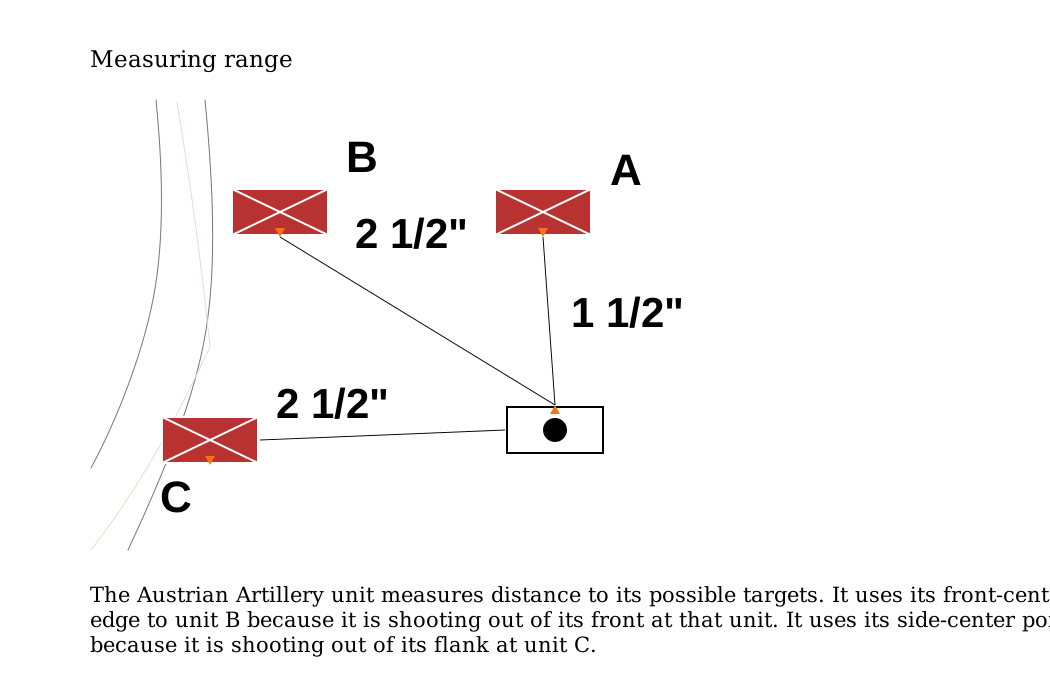
When the rules ask for a range to be measured, or to see if a unit is within X inches of another, then the measuring point is the centre of the nearest face to any edge of the target base.
| Modified Roll | Result |
|---|---|
| 8+ | Target Destroyed |
| 7 | Target Routs |
| 6 | Target Disrupted |
| 5 | Target Pinned |
| 4 or less | No effect |
This phase represents a charge or counter-charge in the grand manner. Note two important restrictions that apply to the act of moving to contact: infantry may not initiate melee against cavalry (formed infantry would form square, not charge), and artillery units may never initiate melee (gunners do not charge). These units may, of course, still be charged and will fight as the defender.
Each player rolls 1D6 and adds modifiers.
Some terrain creates special assaults. Clearing Light Infantry from the edge of Dense Woods is described under Terrain; resolve it as melee using the modifiers listed below.
| Unit is Light Cavalry | −1 |
| Unit is Guards | +1 (cumulative with type and size) |
| Unit is Heavy Cavalry | +2 |
| Unit is Cavalry in town | −2 |
| Enemy is Disrupted | +2 |
| Enemy is in melee with more than one unit | +1 per extra unit beyond one |
| HQ in base-to-base contact | +1 |
| Higher than opponent (i.e. uphill) | +1 |
| Unit is Artillery / HQ / Light Infantry | −3 |
| Clearing Dense Woods: non-Light Infantry attacker | −1 |
| Clearing Dense Woods: defending Light Infantry is Pinned | −1 |
| Unit is “Large” unit | +1 |
| Unit is “Small” unit | −1 |
| Unit is “Common” size | 0 |
| Attacker, subsequent melee (follow-up) | −1 |
| Unit was on the road the whole turn before contact | −2 |
On the multiple-melee modifier: three attackers on one defender means each attacker gets +2.
On the follow-up modifier: if the attacker followed up and contacted another unit, a −1 applies; if it again follows up into another melee, the modifier remains at −1.
On the road-march modifier: a unit that has been moving in road-column the entire turn is caught out of fighting formation if contacted in melee that turn.
| Result | Outcome |
|---|---|
| Totals drawn | Reroll |
| Diff. 1 or 2 | Loser Routs (optional “follow-up”) |
| Diff. 3 | Loser Destroyed (optional “follow-up”) |
| Diff. 4 or more | Loser Destroyed (mandatory “follow-up”) |
After a melee occurs, if the attacker was Routed or Destroyed, the defender does not change facing — but the attacker is aligned in face-to-face contact with the defending unit and routs directly away. If the defender was Routed, first align the defender in front base-to-base contact with the attacker, and then rout the defender directly away from the enemy.
In the case of the loser routing or being Destroyed, the winner has the option of immediately moving by “follow-up” up to a full move directly ahead. Follow-up is resolved after any rout move from the previous melee is completed. If this follow-up move contacts an enemy unit — including a unit that just routed but survived — then another melee is performed. This can be repeated until no more units are contacted.
A unit contacted by follow-up does not receive defensive fire. Defensive fire occurs only in the shooting phase against a unit that moved into contact during the immediately preceding movement phase. A Pinned unit contacted by follow-up fights from its current facing.
If an HQ is in base-to-base contact with a unit (for the purposes of rallying or combat bonuses) and that unit is Destroyed, then the HQ is also Destroyed.
2 by 2 Napoleonic games flow in a manner which reflects my reading of the period and accounts of battles. It is my conceit that a game of 2 by 2 Napoleonic's, when retold, will sound much like the narrative of a real battle. Certain patterns emerge in 2 by 2 games which it is good to know in advance.
As the rules state, when an infantry unit uses small-arms fire it becomes Pinned. As there is likely to be an enemy unit within 2″, it becomes impossible to rally that unit unless it is Guards or in base-to-base contact with an HQ. Infantry of the time usually had one single good volley, then the soldiers started firing as fast as they could — often blindly into the smoke ahead. Once a unit started firing thus, it was incredibly difficult to get it to stop.
In particular, if you are on the attack, you should avoid firing — your attack will stall. Like commanders of the time, you should insist on your troops using the bayonet as the weapon of the offence. That said, an infantry unit's “first volley” (before it becomes Pinned) can be incredibly effective, especially against cavalry.
You will be tempted to use your cavalry, especially Heavy Cavalry, as a metal fist with which to smash the enemy's line. Be cautious. Cavalry is almost certain to lose against infantry, whether it is Pinned or not. Remember: infantry that is neither Pinned nor Disrupted can turn to face when charged, so it is impossible to “catch” such a unit in the flank — except by charging the unit with two attackers. This is a deliberate design decision, as formed infantry could almost always form a square and become invulnerable to cavalry.
This is not to underestimate the power of cavalry. A fast reserve force that can threaten breakthroughs and finish off Disrupted units is an essential part of any force. In particular, cavalry can pose a terrible threat to HQ units caught out in the open. Cavalry is also the king of the multiple-melee turn: it is possible for a cavalry unit to Destroy multiple units in a single turn by use of follow-up.
As you will have noticed in the rules, to rally, a unit needs to be within 6″ of an HQ — and normally you only have one HQ. Even with a movement rate of 6″, HQs will need to be crossing the centre of the board quite often if they are to serve both flanks. If the centre cracks, then entire armies can be cut in two. In addition, HQs can give special attention to critical units by getting into base-to-base contact with them — to lead a special charge, aid in a critical defence, or help rally a stricken unit.
Napoleonic battles were distinctive in how often a battle was determined by the timely arrival, or delayed arrival, of reinforcements — often on the flanks of the enemy. 2 by 2 Napoleonic battles are rarely simple affairs where both sides line up their armies then the battle begins. The feeding-in of forces is an essential part of the game.
Some players will indeed choose to wait for all their forces to arrive from the rear, then form a long battle line before engaging the enemy. This could well be a winning strategy. However, it requires the assent of the opposing general, who may have other ideas — or perhaps not, in which case a grand set-piece battle will result.
Players may pick an army size to fight; the standard army-points (AP) total for pickup games is 40.
| Unit | Cost |
|---|---|
| HQ | 4 AP |
| Line Infantry | 2 AP |
| Guards / Grenadiers | 3 AP |
| Light Infantry | 3 AP |
| Heavy Cavalry | 3 AP |
| Light Cavalry | 3 AP |
| Foot Artillery | 3 AP |
| Horse Artillery | 4 AP |
| Militia | 1 AP |
| Unit is “Large” | +1 AP |
| Unit is “Small” | −0.5 AP † |
† No Militia unit may be “Small”.
| No. | Unit | Cost | Subtotal | Running |
|---|---|---|---|---|
| 1 | HQ | 4 AP | 4 | 4 |
| 10 | Line Infantry | 2 AP | 20 | 24 |
| 2 | Light Cavalry | 3 AP | 6 | 30 |
| 1 | Heavy Cavalry | 3 AP | 3 | 33 |
| 2 | Foot Artillery | 3 AP | 6 | 39 |
Users are encouraged to make up their own army lists, using the unit point costs listed above.
The army lists represent a “Command”. Although 40 AP is the standard, you should be fine having 80-point games under one command. For players who wish for larger point games, the author recommends using multiple Commands across multiple boards. If there is enough interest, a set of “Big Battle” rules can follow — similar to the wonderful DBA rules by Phil Barker and WRG.
Each Command can take up to the indicated amount of units. A minimum number other than zero means that unit must be purchased (usually HQs). For example: 1–3 HQ means at least one HQ must be purchased, but no more than three may be. A number in brackets indicates that if that unit type is purchased, then that is the minimum amount. For example: (2)–6 Line Infantry means that if you choose to buy Line Infantry, you must buy at least two and a maximum of six.
| Allowance | Unit | Cost |
|---|---|---|
| 1–2 | HQ | 4 AP |
| 0–16 | Line Infantry | 2 AP |
| (2)–4 | “Large” Line Infantry | 3 AP |
| (2)–4 | Guards / Grenadiers | 3 AP |
| 0–6 | Heavy Cavalry | 3 AP |
| 0–2 | Light Cavalry | 3 AP |
| 0–5 | Foot Artillery | 3 AP |
| 0–2 | Horse Artillery | 4 AP |
| (2)–6 | Militia | 1 AP |
| Allowance | Unit | Cost |
|---|---|---|
| 1–3 | HQ | 4 AP |
| 0–18 | Line Infantry | 2 AP |
| (2)–6 | Guards / Grenadiers | 3 AP |
| (4) | “Large” Guards / Grenadiers | 4 AP |
| 0–4 | Heavy Cavalry | 3 AP |
| 0–2 | Light Cavalry | 3 AP |
| 0–5 | Foot Artillery | 3 AP |
| 0–2 | Horse Artillery | 4 AP |
| Allowance | Unit | Cost |
|---|---|---|
| 1–2 | HQ | 4 AP |
| 0–12 | Line Infantry | 2 AP |
| 0–4 | Light Infantry | 3 AP |
| 0–3 | Guards / Grenadiers | 3 AP |
| 0–2 | Heavy Cavalry | 3 AP |
| 0–2 | Light Cavalry | 3 AP |
| 0–2 | Horse Artillery | 4 AP |
| 0–4 | Foot Artillery | 3 AP |
The author expects this section may grow over time — some of the current “standard” rules may make their way over here in time if they prove too cumbersome. All of the following should be considered optional and should only be used with the agreement of all players.
These are units (usually non-European tribal forces) who form in order but are not drilled in the European manner. They may be equipped with muskets, bows, or other weapons; for rules purposes these are small-arms. Irregular Shooters receive a −1 when shooting, but cost half an AP less than regular infantry.
| Cost | Move | Range |
|---|---|---|
| 1.5 AP | 3″ | 1″ |
These are units who do not have any missile weapons at all, and who engage in melee combat only. They may carry pikes, swords, axes, spears, or other weapons. Irregular Warbands may not shoot under any circumstances. They receive a +1 to melee rolls.
| Cost | Move | Range |
|---|---|---|
| 2 AP | 3″ | N/A |
These are unconventional or tribal mounted forces — Cossacks, ghazi horsemen, and the like. Fast and numerous, but unreliable: they break and run if their neighbours do. Irregular Cavalry routs whenever any other unit routs within 2″ of it, or passes by within 2″ when routing — that is, the Militia rule, but at the larger range typical of cavalry. They may not initiate melee against infantry (treat as the Infantry-vs-Cavalry rule in reverse: their effort dissolves before contact).
| Cost | Move | Range |
|---|---|---|
| 2 AP | 5″ | N/A |
Light Cavalry units trained with the lance — for example, Polish Lancers. Rory Muir suggests that lancers may have been more effective against disordered units and less effective against ordered cavalry. This optional rule assumes this possibility is correct; the normal rules assume lancers are no better or worse than regular cavalry. Lancers receive a +2 when in melee against any unit that is Disrupted. In addition, Lancers receive a −1 in melee against cavalry at all times.
| Cost | Move | Range |
|---|---|---|
| 3 AP | 5″ | N/A |
Two friendly artillery units in base-to-base contact that can both shoot the same target may fire as a grand battery. Resolve this as a single artillery shot with a +1 modifier. Both artillery units count as having fired.
In larger historical battles where multiple HQs are used to represent corps or division commanders, ignore the +1 shooting modifier for an HQ in base-to-base contact with the firing unit. Keep all normal rally effects and the HQ melee modifier. This preserves the risk-reward decision of committing an HQ to close combat while preventing plentiful HQs from making firing lines too efficient.
If players want a softer terrain grade between Copses and Dense Woods, use Light Woods or Orchards. Infantry may enter Light Woods / Orchards; cavalry, artillery, and HQs may only use roads through them.
If an infantry unit is in melee and has directly to its rear, in full base-to-base contact, a unit of identical type, then it receives a +1 to melee. If this option is taken, then the supporting unit behind must suffer the same combat result as the attacking unit.
Note: the unit must be of identical type. Militia may not support Guards; “Small” Line Infantry may not support “Large” Line Infantry; etc.
These rules owe a great deal to other works, both wargames rules and historical texts on Napoleonic warfare.
Rory Muir — Tactics and the Experience of Battle in the Age of Napoleon
Phil Barker — DBA; with Richard Bodley Scott — Hordes of the Things, DBR
Bruce Quarrie — Napoleon's Campaigns in Miniature
David Chandler — The Campaigns of Napoleon
Bob Connor — Napoleon's War
Donald Featherstone — et al.
John Selby — Recollections of Sergeant Morris
“I don't know what effect these men will have upon the enemy, but, by God, they frighten me.”The Duke of Wellington
Being a list of the honourable ladies and gentlemen who have answered the muster — whether by force of arms upon the table (in splendid isolation or in fine company), by wise counsel freely given, or by no more than reading these articles and wishing the cause well.
Finis.