STAVKA-OKH
A computer wargame by Rod Humble
Windows download
This is a wargame about the Eastern Front during World War Two. You take the role of a senior officer in the Axis or Soviet high command. The Axis command is known as OKH, the Soviet command is known as STAVKA.

Winning the war
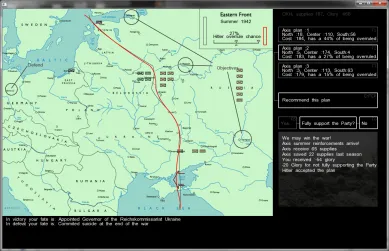
Each turn you select one of three plans generated by your staff to recommend to either Hitler or Stalin.
Each plan lists out how much strength to put in the North, Center and Southern fronts, the remainder is held in reserve for next season.
The central front is key but can be flanked by the northern and southern fronts. Often a massive force aimed at the central front can be defeated by a smaller force if it has flanking advantages in the north or south.
Quite often taking a season to build up a strong reserve as you trade space for time can be very beneficial (if your planning staff come up with it of course).
Until the Allies land in Normandy in summer of 1944 the Axis player receives a significant reserve boost during the summer. Likewise the Soviet player receives extra reserves during winter.
- The Axis win if Moscow and either Leningrad or Stalingrad is captured.
- The Soviets win if Berlin is captured.
- Both sides reach armistice if neither side has won by Spring 1947.
Glory
If a player’s plan is accepted then the player receives the Glory for the plan’s results. Glory can be positive or negative.
If the dictator overrules the plan then he takes all the Glory (positive or negative).
The player’s fate
What happens to the player is displayed at the bottom of the screen. This fate depends on who wins the war.
- If the player’s side wins the war then the higher the Glory the better for the player.
- If the player loses the war then the lower the Glory the better for the player.
Fully supporting the Party
Each season the player can choose whether or not to support the party. Fully supporting the party gains 20 Glory, not fully supporting the party loses 20 Glory.
Controls
There are multiple ways to control the game.
- F1–F4 or 1–4, the up and down arrow keys, or clicking a box selects a plan.
- Tab or the left and right arrow keys change the “Support the party” toggle.
- Space or Enter selects the plan for approval.
- Backspace enters full screen mode.
Designer’s notes
My interest in systems of power within organisations drove this game. Roles such as these high ranking officers are common within many organisations. That of the middle or high ranking executive a couple of rungs from the top. The role has these characteristics:
- The person does not make plans (in the game the staff does that).
- The person does not implement the plans (in the game the soldiers and lower generals do that).
- The person does not even have the final say on whether the plan is to be chosen (in the game the dictator does that).
- The person’s future success is not tied to the success of the organisation (you can lose the war but win the game).
- The person’s actions can have massive consequences for others (in the game this is the war and genocides).
This creates an interactive pattern that the game explores. The person must balance helping the organisation, pleasing the boss and looking out for number 1 while at the same time considering the ethical implications of their actions.
These roles are not fictions. Men such as Adolf Heusinger and Grigory Kulik had dramatically different postwar fates, with Heusinger rising within the ranks of NATO to become its chairman and Kulik being executed by Stalin, even though Heusinger’s side in WW2 lost and Kulik’s side won.
The last factor that impacted the design was an ethical issue. The Eastern Front’s military campaign cannot be untangled from the mass deaths which occurred across the area during it. After the war the military of the losing side claimed not to know about the genocides, the winning side had no need to do so. I chose to use this “turning a blind eye” or not, by the “Fully support the Party?” choice.
Credits
Image use: map from Wikipedia / users Gdrs, Zocky, Markell, Felix116, Foreblast, Mahahaneapneap under the GFDL and Creative Commons Attribution-ShareAlike 3.0 licenses. Black and white images are public domain, from multiple web sources.
Thanks to Brett Humble, Chequers from Qt3, Jason Rohrer, Paolo Pedercini, David Sirlin, Maureen McGuire, Chaim Gingold, Ron Carmel, Daniel Kline, Rich Wilson, Jon Blow, Mike Treanor, all the Bay Area game design meet folks, email list folks and kind colleagues who gave me suggestions and inspiration.
Special thanks to the openFrameworks team and community.